
Prompt Tracking: A Reliable Way to Measure Your AI Visibility or Not?
Does your brand appear in the responses from ChatGPT, Gemini, or Perplexity when potential customers ask questions about your industry? To find out, more and more marketing teams are adopting prompt tracking, or AI prompt monitoring. The principle: regularly submit a series of predefined questions to the AI platforms, then note who is mentioned, cited, or recommended.
Our position is clear. Prompt tracking is an excellent observation tool, but a poor thermometer when read on its own. It reveals trends and competitive gaps, without measuring your actual visibility on its own. In our article on the SEO vs. GEO debate, we already discussed the limitations of AI visibility measurement tools. Let’s go further.
What is prompt tracking in SEO and GEO?
Traditional SEO ranking tracking checks where a page ranks for a keyword in search engine results. Prompt tracking, however, observes how an AI builds its response to a conversational question. It makes it possible to track four signals: AI mentions of your brand, AI citations of your pages as sources, competitors proposed for the same intent, and the context of the recommendation, whether it is a preferred option, a reference, or a simple mention.
Be careful, however, not to confuse the two concepts. An AI can recommend your company without a link to your site, or cite your page without ever naming your brand. These two signals tell different stories and deserve separate tracking.
Prompt tracking and traditional SEO tracking: what are the differences?
| Suivi SEO traditionnel | |
|---|---|
| Unité observée | Requêtes et pages identifiables |
| Signaux suivis | Impressions, clics, positions |
| Sources de données | Google Search Console, outils d’analyse |
| Lien avec le trafic | Direct et mesurable |
| Prompt tracking | |
|---|---|
| Unité observée | Questions conversationnelles et intentions |
| Signaux suivis | Mentions, citations, recommandations |
| Sources de données | Tests répétés sur les plateformes IA |
| Lien avec le trafic | Partiel, souvent sans clic |
The two approaches complement each other: by cross-referencing their data, we gain a better understanding of the user search journey.
Why should prompt tracking results be interpreted with caution?
Ask ChatGPT the same question three times: the proposed brands, the cited sources, and their order may change. Rand Fishkin, co-founder of SparkToro, demonstrated this in early 2026. Around 600 volunteers ran 12 identical prompts nearly 3,000 times on ChatGPT, Claude, and Google’s AI, and the probability of getting the same list of brands twice was less than 1 in 100. His conclusion is blunt: “Accurately measuring your brand’s presence in AI responses is a mission impossible”
Fishkin does qualify this, however: a visibility percentage calculated on tens or hundreds of prompts, run multiple times, remains a reasonable indicator. This is precisely our reading. Forget the “position in ChatGPT” and instead track the frequency of appearance.
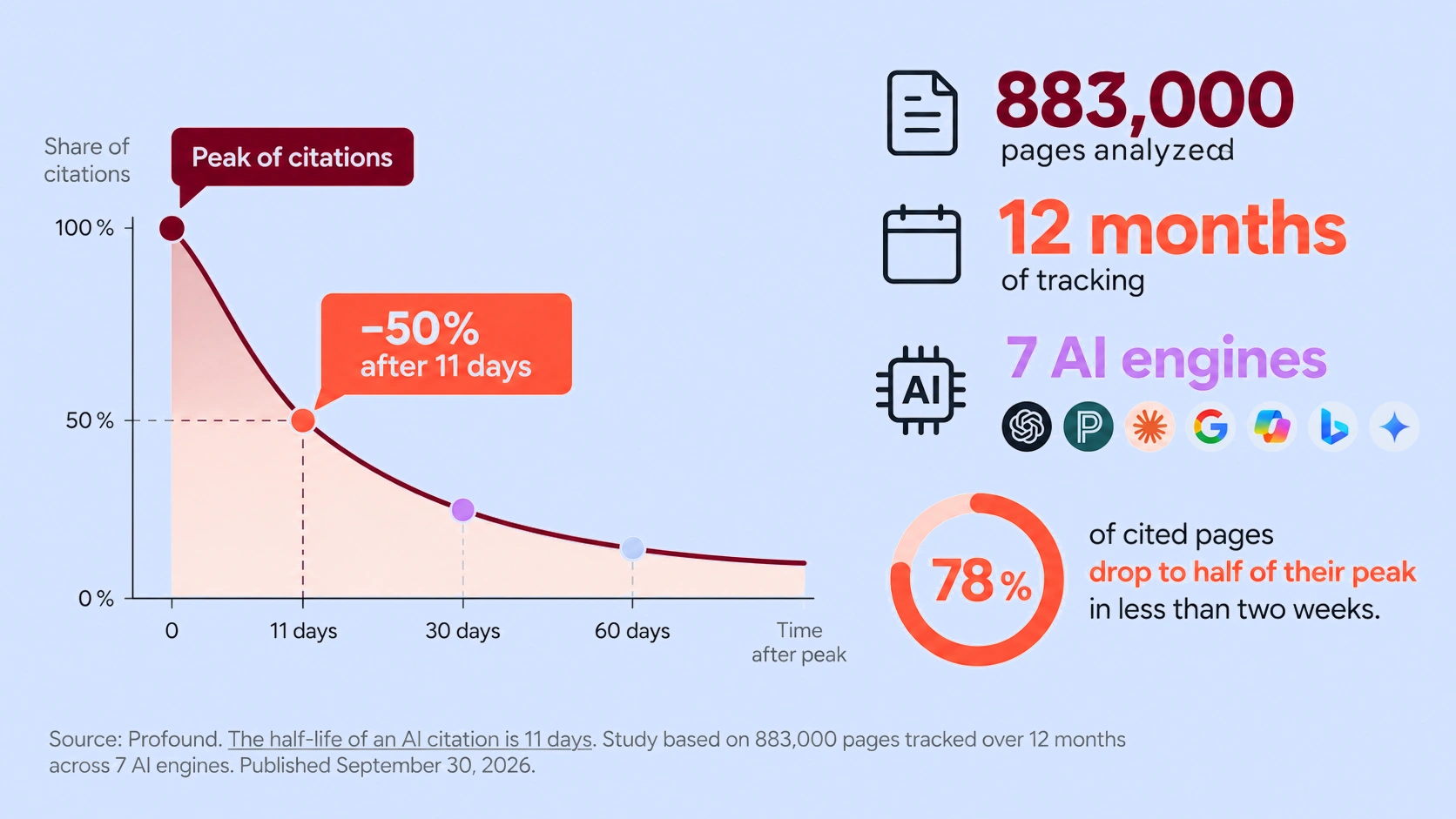
Research published by Profound points in the same direction. Out of 883,000 pages tracked over 12 months across 7 AI engines, the median page loses half of its share of citations 11 days after its peak.
In other words, even when a page gains visibility in an engine, this signal can erode quickly – and without replicating itself in the same way across other platforms.
Personalization changes what each user sees
Memory, conversation history, language, location, and the sources consulted at the time of the search influence each response. OpenAI specifies this in its documentation on ChatGPT memory: past exchanges can be used to personalize responses. An automated tool therefore reproduces test conditions, not the experience of each of your customers.
The choice of prompts can bias the entire analysis
In our opinion, this is the most underestimated limitation. A company that only tracks questions tailored to its products will obtain a flattering score, with no guarantee that it reflects the questions its customers are actually asking. And unlike SEO, we do not have reliable search volumes for every conversational phrasing. Prompt tracking therefore measures your visibility on a sample of questions, never on all conversations.
How to build a relevant prompt tracking strategy?
The quality of the method matters more than the number of prompts tracked.
Start from your customers’ actual intents
Your SEO data, keyword research, and the questions your sales teams receive are the best starting points. Then combine informational, comparative, and commercial questions. A company specializing in printers will thus track “Which printer to choose for a small business?” just as much as “Laser or inkjet printer: which one to choose?” or “Which brands offer printers suitable for SMEs?”. Each phrasing sheds light on a different stage of the decision-making journey.
Diversify platforms and document test conditions
Being present on ChatGPT guarantees nothing on Gemini, Claude, or Perplexity. Compare platforms and systematically note the language, market, date, and search mode used. To limit the effect of history, launch your tests in new conversations, with reduced personalization.
Repeat tests and read trends
An isolated result is an observation, not a trend. Repeat your prompts at different times and maintain a stable set over time, because constantly changing questions makes any evolution unreadable. As for the number of repetitions, the profession has no consensus. The right number depends on your objective, the level of confidence sought, and your resources, and your methodology must state this clearly.
Cross-reference AI signals with your SEO and business data
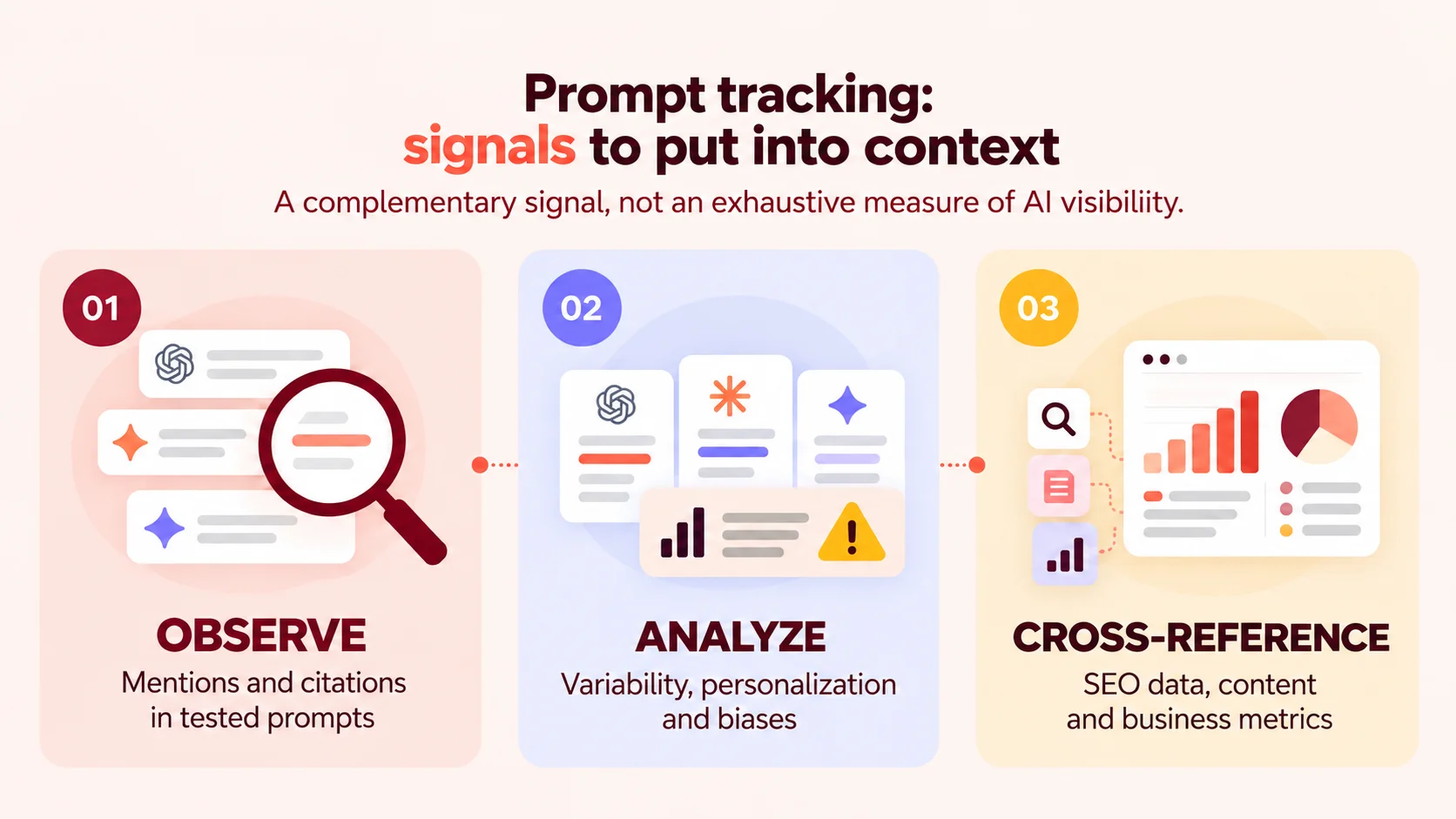
Prompt tracking takes on its full value when compared with other sources. Tools like Semrush and Ahrefs make it possible to track mentions, citations, and competitive visibility in AI responses. However, their results are based on prompt samples and estimation methodologies, not on all actual user interactions.
This data is useful for identifying trends and guiding a GEO strategy, but it must be interpreted with caution. AI responses vary according to the phrasing of questions, context, personalization, and location. An AI visibility score therefore remains an estimate, and not an exact measurement of a brand’s actual exposure.
Conversely, Google and Bing have data from their own search and AI systems:
- Google Search Console: its generative AI performance reports, rolled out to all sites at the end of August 2026, make it possible to analyze impressions and pages displayed in Google’s AI features, among other things.
- Bing Webmaster Tools: its AI Performance report presents page citations in Microsoft Copilot, Bing, and certain partner integrations. It allows you to examine grounding queries, associated intents, and the share of citations. The new Topics Portfolio (beta) feature also groups these queries by theme to identify content opportunities.
This first-hand data provides a complementary perspective, without offering an exhaustive view of user interactions. In particular, Bing’s grounding queries are sampled, while certain thematic estimates remain approximate.
GA4 completes this analysis by making it possible to identify some of the traffic coming from AI platforms, while conversion metrics make it possible to align these observations with business objectives.
The challenge is therefore to distinguish visibility estimates from observed performance metrics, and then cross-reference these signals to make informed decisions.
Our approach at Dialekta: turning observations into decisions
At Dialekta, we view prompt tracking as a source of observations complementary to a broader SEO and GEO strategy, and not as a reliable and exhaustive measurement of AI visibility.
Despite its limitations, it can be interesting to observe a brand’s mentions, citations, and absences across a set of targeted questions. These results must nevertheless be interpreted with caution, as they depend in particular on the selected prompts, test conditions, and the variability of responses.
Our approach therefore consists of treating these observations as avenues to explore, putting them into context, and comparing them with other SEO and marketing data before drawing conclusions.
Take the example of a brand rarely mentioned in AI responses to comparative questions, while its competitors appear regularly. This finding does not necessarily mean that its overall visibility is low or that its content has shortcomings. It can nevertheless raise relevant questions about how its products are presented, compared, and accessible.
The goal is not to optimize content to artificially improve an AI visibility score, but to integrate these observations into a broader analysis, without giving them disproportionate importance.
Is prompt tracking a reliable indicator of GEO performance?
Yes, as an observation indicator. No, as an exhaustive measurement of visibility or return on investment. A mention rate calculated on a selection of prompts does not represent the actual probability that a customer will encounter your brand in an AI conversation.
The right question is therefore no longer “Are we visible in ChatGPT?”, but “What does our presence in AI responses reveal about our ability to meet our customers’ needs?”. To build a GEO measurement useful for your decisions, discover our GEO support.
How Dialekta can help you turn these observations into actions
Prompt tracking can reveal opportunities, but you still need to know how to interpret them and which ones to act on.
At Dialekta, our GEO support goes beyond monitoring AI mentions and citations. We identify the questions relevant to your customers, analyze your presence compared to that of your competitors, and cross-reference these observations with your SEO data and business goals.
This approach allows us to prioritize concrete actions on your content, your site, and your digital visibility, without limiting ourselves to a simple AI visibility score.
Move from observations to decisions with our SEO/GEO team.
Frequently asked questions about prompt tracking
Can you precisely measure your position in ChatGPT?
No, not like an SEO position. Responses vary from one run to the next. It is better to analyze the frequency and context of mentions across a set of documented tests.
How many prompts should be tracked?
There is no universal number. Everything depends on your categories, your markets, the targeted intents, and the precision sought. A balanced and representative sample is worth more than a long list of irrelevant questions.
Can GEO ROI be measured with prompt tracking?
Not directly. Prompt tracking provides indicators of presence and citability. To evaluate business results, they must be cross-referenced with your traffic and conversion data, keeping the limits of attribution in mind.