
Agentic AI and CRM: How to Transform Your Relationship Marketing and Automate Your Actions
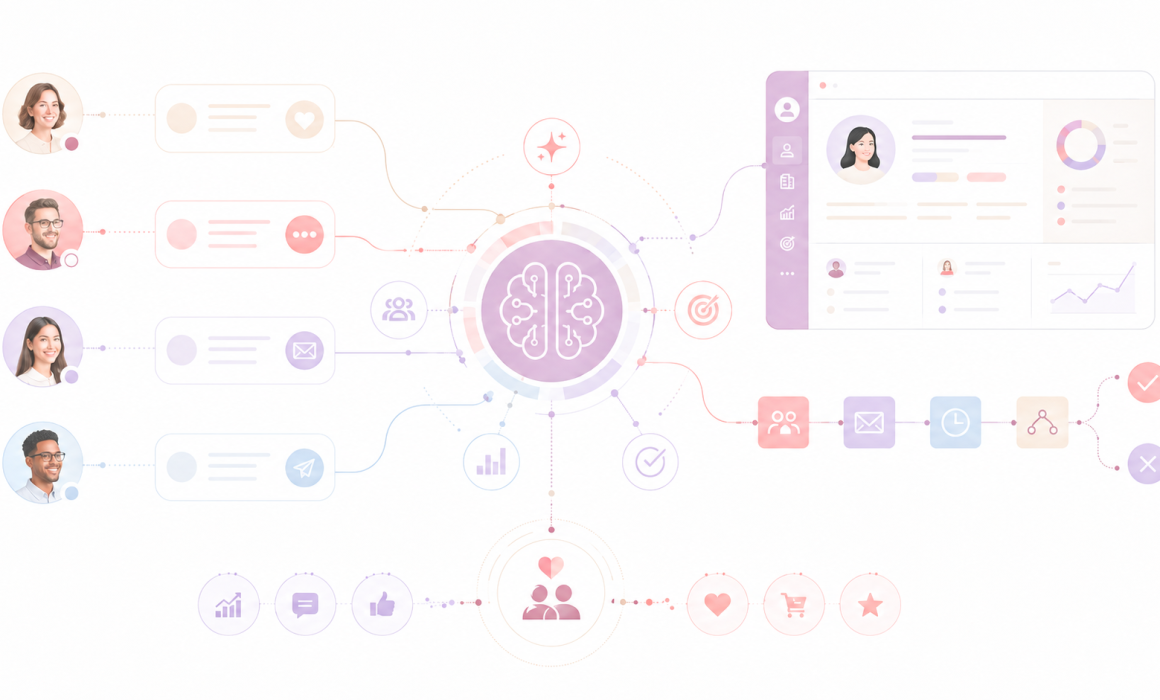
CRMs like Salesforce, Klaviyo, HubSpot, or Microsoft Dynamics 365, now integrate agents capable of going beyond analysis or content generation. They can also trigger actions, sometimes autonomously: qualifying a lead, re-engaging a client, recommending an offer, or handling a service request.
This evolution changes the very nature of CRM and marketing automation. We are no longer talking just about a tool that centralizes information, but about a system that starts to take action.
But what is an AI agent in a CRM? What can we actually entrust to it? And under what conditions?
What is an AI Agent in a CRM?
An AI agent in a CRM is a system that understands a customer context, chooses an action among several options, and can execute it within connected tools.
We can entrust it with simple, repetitive, or reversible tasks. On the other hand, as soon as a decision has a significant financial, legal, or relational impact, human supervision remains necessary.
What does an AI agent in a CRM actually do?
An AI agent doesn’t just answer a request. It acts based on a goal.
It can analyze a situation, consult data, decide on a sequence of actions, and execute them in the CRM or connected tools.
Depending on its access level, it can, for example:
- consult a customer’s history
- estimate their level of interest
- draft a message
- choose the right time or channel for a follow-up
- update a customer profile
- trigger a workflow
- or transfer a file to a human team.
Its operation relies on a few simple elements: a goal, available data, authorized actions, and rules that frame what it can or cannot do.
In a marketing context, for example, it can analyze a visitor’s behavior on a site, identify their level of interest, and then decide on the best action: offer them a personalized offer, trigger an email sequence, adjust the content displayed on a landing page, or pass the lead to the sales team at the right time.
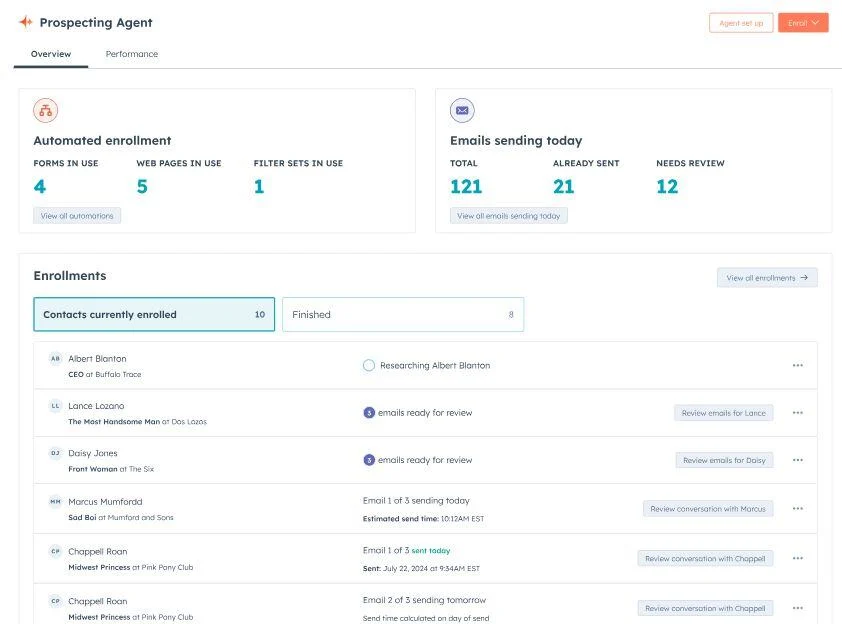
Example of AI agents – Hubspot
What is the difference between an AI agent and marketing automation?
Marketing automation relies on pre-defined scenarios. A condition triggers a specific action.
An AI agent works differently. It starts from a goal and adapts to the context to decide on the best sequence of actions.
Marketing automation executes a planned scenario. The agent chooses what it does based on the situation.
|
Dimension |
Marketing automation |
AI agent |
|
Starting point |
Rule or trigger |
Goal and context |
|
Journey |
Programmed sequence |
Adapted sequence |
|
Decision |
Preprogrammed with business rules |
Dynamic: choice between multiple actions |
|
Control |
Testing before deployment |
Continuous testing and monitoring |
|
Risk |
Limited to the rule |
Variable depending on context |
This does not mean that the agent “understands” like a human. It selects actions based on models, data, and rules defined by the company.
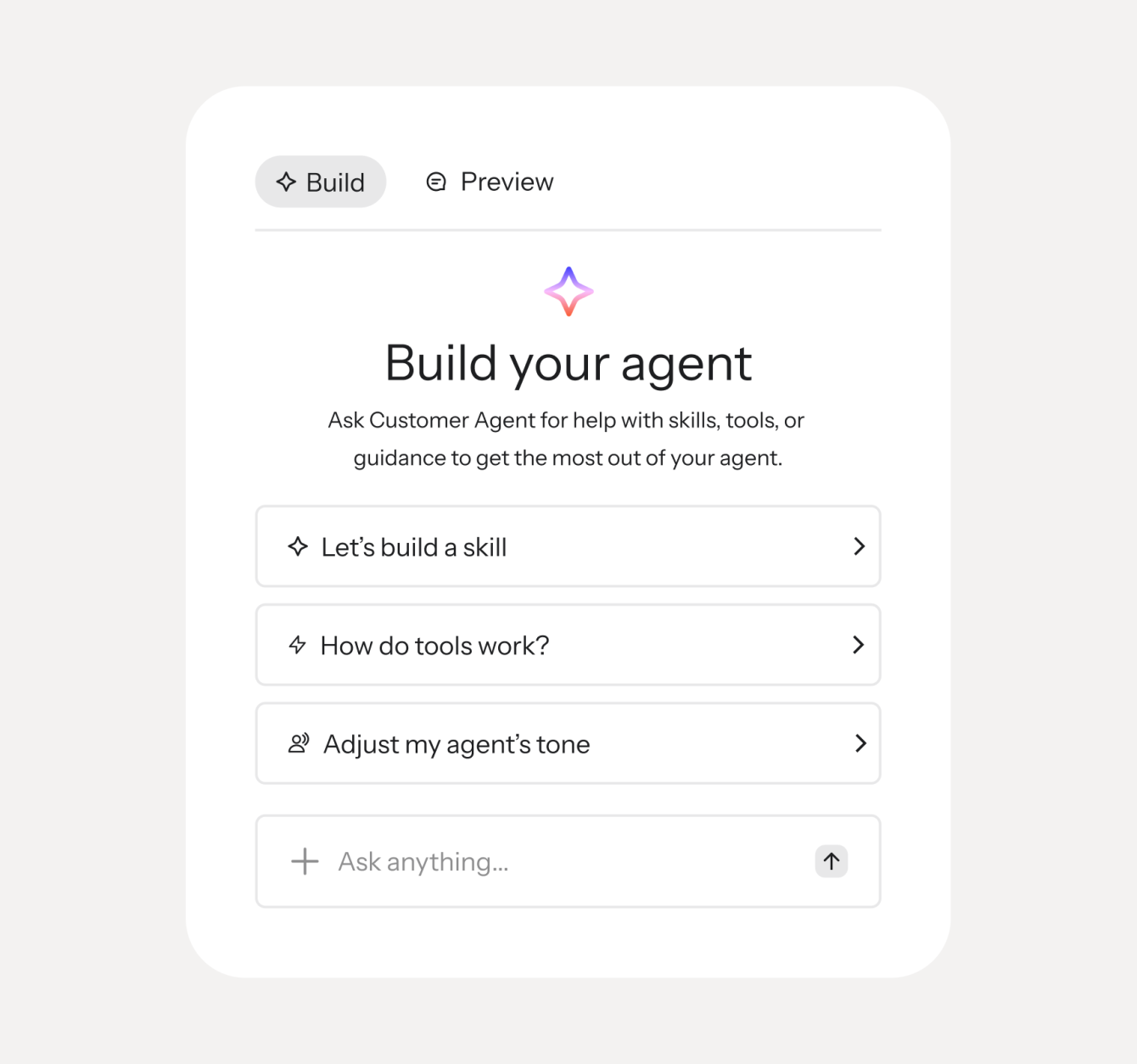
Example of AI agents – Klaviyo
Predictive, generative, or agentic AI?
We often mix several types of AI in CRMs.
- Predictive AI estimates a probability (purchase, churn, conversion).
- Generative AI produces content (text, summary, response).
- Assistance AI suggests an action but leaves the human to decide.
- Agentic AI goes further: it chooses and executes actions to achieve a goal.
The term “agent” is therefore not enough. We must look at what the system actually does: does it recommend, prepare, or act?
Are CRM platforms becoming systems of action?
Publishers are all moving in this direction.
Salesforce, with Agentforce, highlights agents capable of qualifying prospects, answering customers, or managing certain order steps. Klaviyo claims its K:AI agents can detect opportunities, build campaigns, and handle certain service requests. HubSpot allows its prospecting agent to research accounts, prepare approaches, and in some cases, send emails automatically.
Adobe, Microsoft, Braze, Bloomreach, Oracle, Zendesk, and Intercom are also developing agents for marketing, commerce, or support. We are progressively moving from a CRM that records to a CRM that acts, but the level of autonomy varies greatly from one platform to another: some are limited to recommendations, while others already allow direct execution.
What are the main use cases and their risks?
Lead Qualification
An agent can analyze available data, a prospect’s behavior, and past interactions. It can enrich the record, suggest a score, or transfer the contact to sales.
The main risk is misinterpreting a signal or reproducing biases present in historical data.
Follow-up Orchestration
The agent can decide when to follow up, through which channel, and with what message. It can also adjust the pace based on the customer’s reactions.
Risks include over-solicitation, using an unauthorized channel, and inconsistencies between communications.
Customer Service
An agent can answer simple questions, check an order, or initiate a return.
Things become more sensitive as soon as it can modify a contract, grant a commercial gesture, or financially commit the company.
Next Best Action
Some agents directly suggest the next action to take: an offer, content, or a channel.
This is useful for personalization, but it can also become intrusive or hard to explain if the logic is not clear.
What levels of autonomy can be granted?
Autonomy is not binary. It can evolve progressively.
- Observe: the agent analyzes without acting
- Recommend: it proposes an action to a human
- Prepare: it builds the action to be approved.
- Execute under conditions: it acts within predefined limits.
- Execute and document: it acts, logs its decisions, and escalates exceptions.
The higher you go in these levels, the more important the need for control remains, even if humans intervene less often.
Is your CRM ready to hand over the reins to an agent?
An agent depends entirely on data quality and the framework in which it operates.
In particular, you need:
- a consistent customer identity
- reliable and up-to-date data
- clear consents
- usable history
- a validated knowledge base
- well-defined permissions.
A qualification agent does not need access to all financial data. A service agent should not be able to grant compensation without an explicit threshold.
An agent does not improve a poorly structured CRM. It simply accelerates its flaws.
How to decide what can be delegated?
Five simple questions can help you decide:
- Can the action be easily cancelled?
- Does it have a financial or legal impact?
- Is the data reliable?
- Is the error quickly detectable?
- Can a human take back control?
The riskier or harder a decision is to correct, the less it should be automated.
What safeguards should be put in place?
An agent must be framed from its design:
- clear role and objective
- limited data access
- defined authorized actions;
- financial thresholds
- human validation on sensitive cases
- action log
- regular testing
- possibility of rapid deactivation
Traceability is essential: you must be able to understand what the agent did and why.
What does Law 25 provide?
In Quebec, Law 25 governs decisions made based on automated processing of personal data.
When a decision is entirely automated, the concerned individual must be informed. The law may require explanations, access to the data used, and a human review.
The use of AI does not systematically lead to a decision in the legal sense: everything rests on the context and the actual scope of its impact.
*This general information does not constitute legal advice.
Where to start?
The simplest approach is to start small. The first pilot should target a frequent, well-documented, measurable task based on accessible data and associated with limited risk.
The agent can start in observation mode. Its recommendations are then compared to human decisions. The company can then allow it to prepare certain actions, and then execute a few within a restricted perimeter.
Autonomy must be earned through results, not granted by default.
Conclusion
Agentic AI could cause the CRM to evolve from a system that stores data and executes scenarios into a system capable of selecting and accomplishing actions.
But the true transformation will not depend on the number of deployed agents. It will depend on companies’ ability to provide them with reliable context, limit their permissions, track their decisions, and measure their results.
The competitive advantage will go to organizations capable of progressively delegating the right decisions within an explainable, measurable, and reversible framework.

Written by Marie Broudic, Data Director at Dialekta